Examples of games created with the MQ Creator PRO by Musiquence Technologies. Try MQ Creator FREE for free.
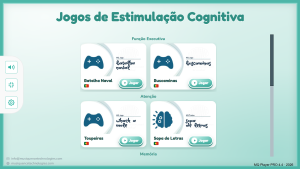
All games include an initial instruction screen, automatic level progression, transition screens, immediate feedback, and a “Congratulations” message at the end of each level. The professional mode records user times, errors, and performance.
Note: The domains described refer to the abilities exercised by each activity and do not constitute validated clinical or assessment instruments.
★ Cognitive Games Collection
9 Progressive Games (≈10 minutes each)

Tap the moles that appear in the holes before they disappear.
Domains: sustained and selective attention, processing speed, reaction time, hand-eye coordination, and visual scanning.
Progression: 8 levels. Starts with 3 holes and 1 mole for 4 seconds and ends with 6 holes, up to 3 simultaneous moles, and only 1.4 seconds to react.
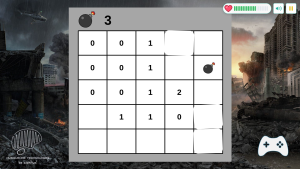
Open all safe tiles using the numbers to discover where the mines are hidden.
Domains: logical and deductive reasoning, planning, inhibitory control, and attention to detail.
Progression: 12 boards, from 3×3 with 1 mine up to 8×8 with 12 mines.
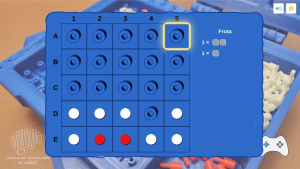
Discover the position of hidden ships in an increasingly complex fleet.
Domains: spatial reasoning, hypothesis generation, working memory, planning, and cognitive flexibility.
Progression: 13 boards, from 5×5 with 2 ships to larger fleets on 8×8 boards.
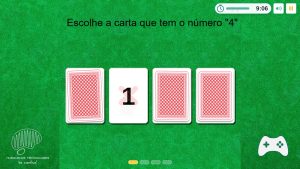
Memorize the location of numbers and find them after the cards are covered.
Domains: short-term visuospatial memory, working memory, attention, and trial-and-error learning.
Progression: levels with temporary card exposure and advanced levels where players learn solely from errors. Includes a visual progress bar.
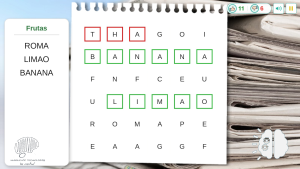
Find words related to different themes in a letter grid.
Domains: visual scanning, selective attention, lexical recognition, language, and processing speed.
Progression: 9 puzzles, from 6×6 grids with horizontal words to 12×12 grids with words in all directions.
Solve addition problems by choosing the correct answer or identifying the missing number.
Domains: mental arithmetic, number sense, working memory, and attention.
Solve subtraction problems and exercises with an unknown element.
Domains: calculation, numerical reasoning, inverse reasoning, and attention.
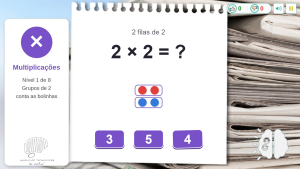
Solve multiplication problems with visual support and later without support.
Domains: numerical reasoning, understanding of groups, and arithmetic memory.
Solve progressively more complex division problems.
Domains: mathematical reasoning, numerical relationships, working memory, and attention.
Progression: all operations include 8 to 9 levels, starting with concrete representations and progressing to abstract calculations up to 100 and the use of complete multiplication tables.
These games demonstrate how MQ Creator enables the creation of educational, cognitive, therapeutic, and research experiences without complex programming. The platform includes multimedia content, metrics collection, automatic progression, immediate feedback, personalization, and support for multiple devices.